
Emergency Garage Door Repair
Doors stuck open, hanging crooked, or off the guide, made safe first.
View serviceThe door is not broken — it is stuck to the concrete. Forcing it with the opener is what turns this into a repair.
Stop pressing the button. Clear snow and ice from the full width of the threshold, inside and out, then break the bond gently: warm water along the seal line, or careful use of a heat source that is not a flame, and a plastic — never metal — scraper along the ice at the base. Once the door is free, dry the threshold and inspect the seal. If the opener has already been forced against the bond, have the door and cables checked before regular use.
A door frozen to the slab is one of the few garage door problems where doing nothing is genuinely better than doing something. The bottom weatherseal is a rubber strip designed to sit against concrete, and when meltwater collects at that line and refreezes, it bonds the two together. Water expands when it freezes, so each round of freezing, melting and refreezing works the bond deeper and harder. The mechanism is simple and so is the damage: press the button and the opener will either tear the seal, strain the cables, or trip its force protection trying to break a bond it was never built to break.
Start at the top. The early checks are the most common causes and need no tools.
Every press against a frozen bond loads the cables unevenly, strains the drive gear and can trip or damage the operator. If the door has already tried and reversed, leave it. Disconnect the opener at the release cord so nobody else in the household tries again.
What it means: Doing nothing at this point prevents almost all of the possible damage.
Shovel and sweep snow away from the base of the door on both sides, and get the packed ridge that forms where a plow or a shovel has pushed snow against the opening. On the one-car-deep driveways common in Milton that ridge ends up right at the door line.
What it means: Sometimes the door releases as soon as the load of packed snow is removed.
Warm — not boiling — water poured along the seal line will usually release it, and a hair dryer or heat gun works where power is available. A plastic scraper can chip ice at the base. Never use a metal blade against the seal and never use an open flame anywhere near the door.
What it means: Once the bond releases the door will lift normally; if it does not, something else is wrong.
With the opener still disconnected, lift the door by hand a short way. If it moves freely, reconnect and use it normally. If it feels heavy, binds or one side lags, the freeze may have been the last straw for a cable or a spring already near the end of its life.
What it means: A free hand-lift means you are done; a heavy one means book an inspection.
Clear the remaining water and slush from the threshold so it does not simply refreeze tonight, then look at the bottom seal for tears, hardening or sections pulled out of the retainer. A damaged seal is why this recurs, and it is one of the cheapest parts of the door.
What it means: A torn or hardened seal should be replaced before the next cold spell.
Do not use an open flame, a blowtorch or a propane heater at the door line — seals, insulation and paint all burn and garages store flammable things. Do not chip at ice with a metal blade against the weatherseal, which is how a seal that could have been saved gets destroyed. Do not put salt directly against the threshold as a routine measure, because salted meltwater is what corrodes the bottom brackets and cable ends. And do not hold the opener button down to overpower the bond.
Milton has more of this than the lakeshore municipalities do. The town’s normals give a January daily mean of -6.8 C, a mean daily minimum of -10.4 C, about 45.2 cm of snow in January alone and roughly 161.4 cm across the year, while Halton Region’s own figures record around 81.0 cm a season in Oakville and 99.9 cm in Burlington. More snow at the threshold means more meltwater, and Boyne Survey driveways held to between 5.5 and 7.0 metres leave nowhere to put it except near the door.
Fill out the form and we'll confirm your appointment by email.
These guides are written for Milton homes. If the fix is beyond a homeowner check, we work everywhere inside this area.
Map data © Google. Pin shows the service area, not a walk-in location — all work is done at your home.
A real callout, not stock imagery.
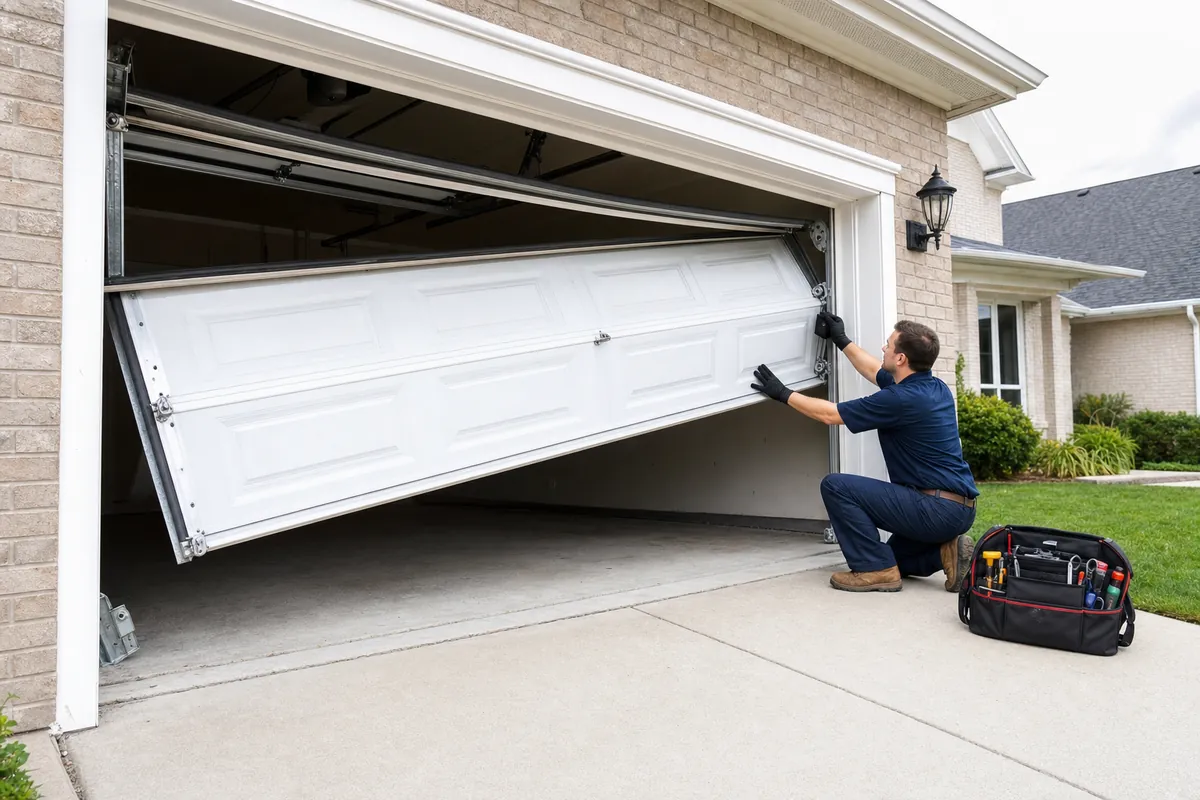
A sectional door pulled off its tracks, taken down and supported on site so it could be checked and re-hung safely — photographed on the job.
