
Garage Door Maintenance & Tune-Up
Yearly checks on balance, hardware, seals, sensors and safety reversal.
View serviceDifferent noises point at different parts. Learning which is which tells you whether this is a lubrication job or a warning.
A single loud bang followed by a door that will not lift is a broken spring — stop and get it looked at. Continuous grinding or squealing that tracks the door’s movement is usually dry or seized roller bearings. Rattling is loose hinges, track brackets and fixings. A slam at the end of travel points at balance or opener limits. Popping from overhead as the door moves points at the hinges and the section joints.
Garage doors get louder gradually, which is why most households stop hearing it until a visitor mentions it or a baby starts sleeping in the room above the garage. That room matters in Milton: roughly 73 per cent of the town’s occupied dwellings were built in 2001 or later, and that housing overwhelmingly puts habitable rooms directly above or beside an attached garage. The useful thing about door noise is that it is specific. A grind is not a bang and a squeal is not a rattle, and each points at a different component, so identifying the sound gets you most of the way to the cause.
Start at the top. The early checks are the most common causes and need no tools.
A single event — a bang, a crack, a snap — is a component failing, most often a torsion spring. A continuous noise that follows the door up and down is wear, friction or looseness. This one distinction sorts the urgent from the routine before you look at anything.
What it means: One loud bang means stop using the door; continuous noise can wait for a scheduled visit.
From inside, with the door closed, look at the torsion spring on the shaft above the opening. A broken spring shows an unmistakable gap of a few centimetres where the coil has separated. Look but do not touch, and do not try to lift the door to test it.
What it means: A visible gap in the coil is a broken spring and a replacement job, not a repair.
With the opener disconnected, move the door slowly through its travel. Noise at a consistent point suggests a specific roller, hinge or piece of track; noise throughout suggests the whole roller set is dry. Watch for a roller that skids rather than rotates.
What it means: Locating the noise by hand narrows it to a part rather than a system.
Look into the bottom half-metre of each vertical track. Leaf litter, sand and frozen salted slush collect there and act as small obstructions that lift a roller momentarily, which is the shudder-and-clunk on the first few feet of travel. Clear it out; do not put grease in.
What it means: A clean dry track plus lubricated rollers eliminates most first-metre noise.
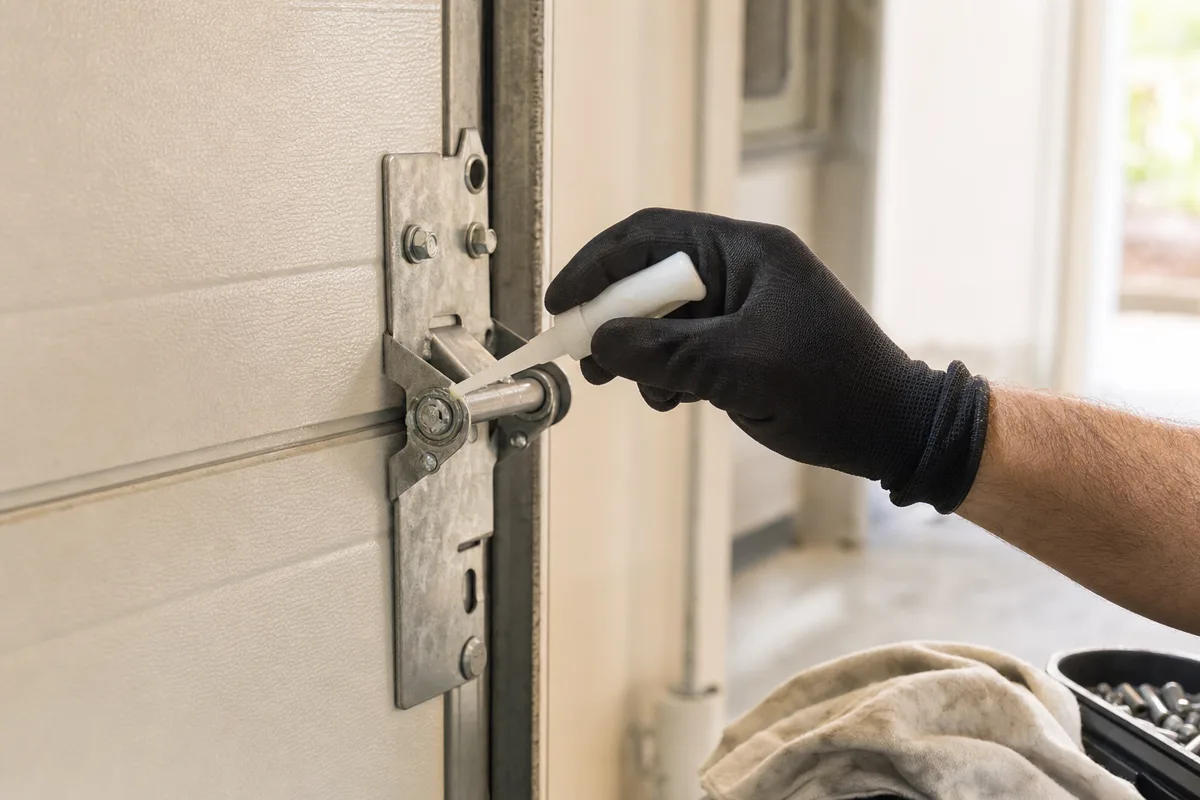
Rattling usually means hinge screws and track brackets have worked loose over thousands of cycles. Bring them up snug by hand and lubricate the hinges, roller stems, bearings and spring coils with a garage-door product — not the track, and not a general-purpose grease.
What it means: If the noise persists after lubrication and tightening, parts are worn rather than dry.
The bottom roller brackets at each side of the door are attached to the lift cables and are under full spring tension, so they are not a fixing to tighten or adjust. Do not touch the springs, the drums, the cables or the centre bearing plate, and do not try to silence a noise by adding tension. If the noise was a single loud bang, treat the door as unsafe to operate until it has been inspected — a door with a failed spring is held by cables that may already be compromised.
Milton’s newer housing makes door noise unusually noticeable and its winters make it worse. Nearly all of the post-2001 stock has an attached garage with rooms above or beside it, so a dry roller bearing is a bedroom problem rather than a garage problem. Meanwhile a season bringing about 161.4 cm of snow puts grit and salted slush into the bottom of the vertical track for months, and cold thickens whatever lubricant is left. Sealed nylon rollers are the single most effective quietening measure on most Milton doors.
Fill out the form and we'll confirm your appointment by email.
These guides are written for Milton homes. If the fix is beyond a homeowner check, we work everywhere inside this area.
Map data © Google. Pin shows the service area, not a walk-in location — all work is done at your home.

A real callout, not stock imagery.
A sectional door pulled off its tracks, taken down and supported on site so it could be checked and re-hung safely — photographed on the job.
