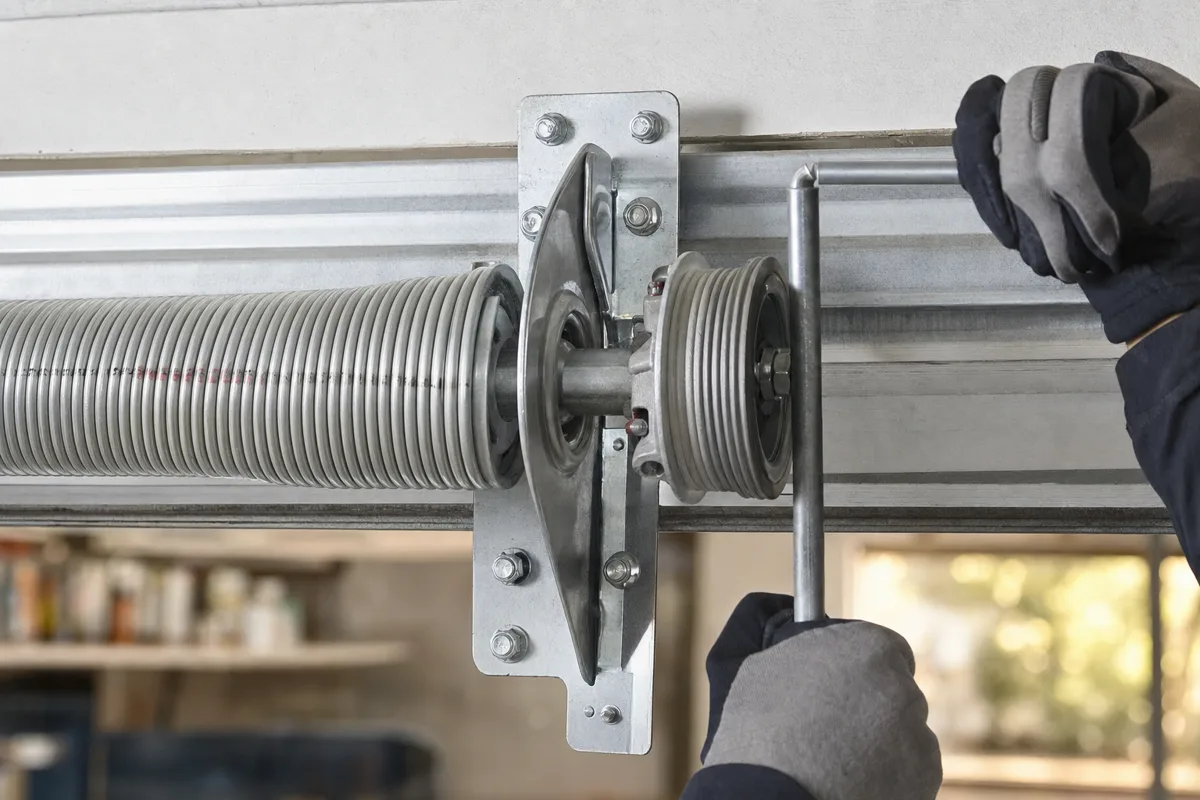

Garage Door Spring Replacement
Springs specified from door weight and drum size, then wound to the calculated turns.
View serviceThe springs do the lifting, not the opener. Here is how to confirm one has failed, and what not to do next.
Look at the spring on the shaft above the door: a gap of a few centimetres in the coil means it is broken. Other reliable signs are a single loud bang from the garage, a door far too heavy to lift by hand with the opener disconnected, an opener that runs while the door barely moves, and a door that rises a foot and drops back. Do not attempt the replacement — torsion springs need specific winding bars and hold enough energy to break bones.
The most useful fact about garage doors is also the least understood one: the opener does not lift the door. Torsion springs above the opening counterbalance almost all of the door’s weight, and the operator only overcomes the small remainder and guides the travel. So when a spring fails, the opener is suddenly asked to do a job it was never built for, and every symptom people describe follows from that. Milton produces a lot of this work right now because whole neighbourhoods went up in tight construction windows and their original springs reach the end of their rated cycles together.
Start at the top. The early checks are the most common causes and need no tools.
From inside the garage with the door closed, look at the shaft above the opening. An intact torsion spring is a continuous tight coil; a broken one has an obvious separation of a few centimetres, sometimes with the ends slightly splayed. This is the clearest single indicator there is.
What it means: A visible gap is a confirmed broken spring — stop using the door.
A spring failing releases its stored energy at once and the report is loud enough to be heard through the house, often at night when the temperature is at its lowest. Milton’s January mean daily minimum is -10.4 C, and the coldest hours are when a fatigued spring gives up.
What it means: A bang followed by a door that will not lift is a spring until proven otherwise.
With the door fully closed, pull the emergency release to disconnect the opener, then try to lift the door a little. A door with working springs is manageable; a door with a broken spring is startlingly heavy. Lift only enough to feel it and do not try to raise it fully.
What it means: A door that will not budge by hand has lost its counterbalance.
If the motor runs, the chain or belt moves and the door either does not follow or rises a short way and stops, the opener is meeting a load it cannot handle and its force protection is intervening. Do not keep pressing the button to force it.
What it means: A straining opener with a barely moving door points at the counterbalance, not the motor.
A spring failure shock-loads the lift cables. Look at both sides for a cable hanging slack, coming off its drum, or showing broken strands near the bottom bracket. Note what you see and include it in the request rather than touching anything.
What it means: Cables damaged alongside the spring are part of the same repair.
This is the one garage door job that should never be attempted at home. A torsion spring at working tension holds enough energy to break an arm or worse, winding bars are specific tools with no safe substitute — screwdrivers and adjustable wrenches are how people get seriously hurt — and a broken spring leaves the door held only by cables that may already be compromised. Leave the opener disconnected so nobody can energise it, keep vehicles and children out of the opening, and do not try to lift the door.
Milton’s build history explains the pattern of spring work here. Sixty-one per cent of Beaty dwellings date from 2001 to 2005, 89 per cent of Coates from 2006 to 2010 and 88 per cent of Willmott from 2011 to 2016, so streets reach their springs’ rated cycle counts as cohorts rather than one house at a time. Add households that use the attached garage as the main entrance and a January daily mean of -6.8 C, and the result is a run of failures along the same crescent within a couple of cold weeks.
Fill out the form and we'll confirm your appointment by email.
These guides are written for Milton homes. If the fix is beyond a homeowner check, we work everywhere inside this area.
Map data © Google. Pin shows the service area, not a walk-in location — all work is done at your home.

A real callout, not stock imagery.
A sectional door pulled off its tracks, taken down and supported on site so it could be checked and re-hung safely — photographed on the job.
