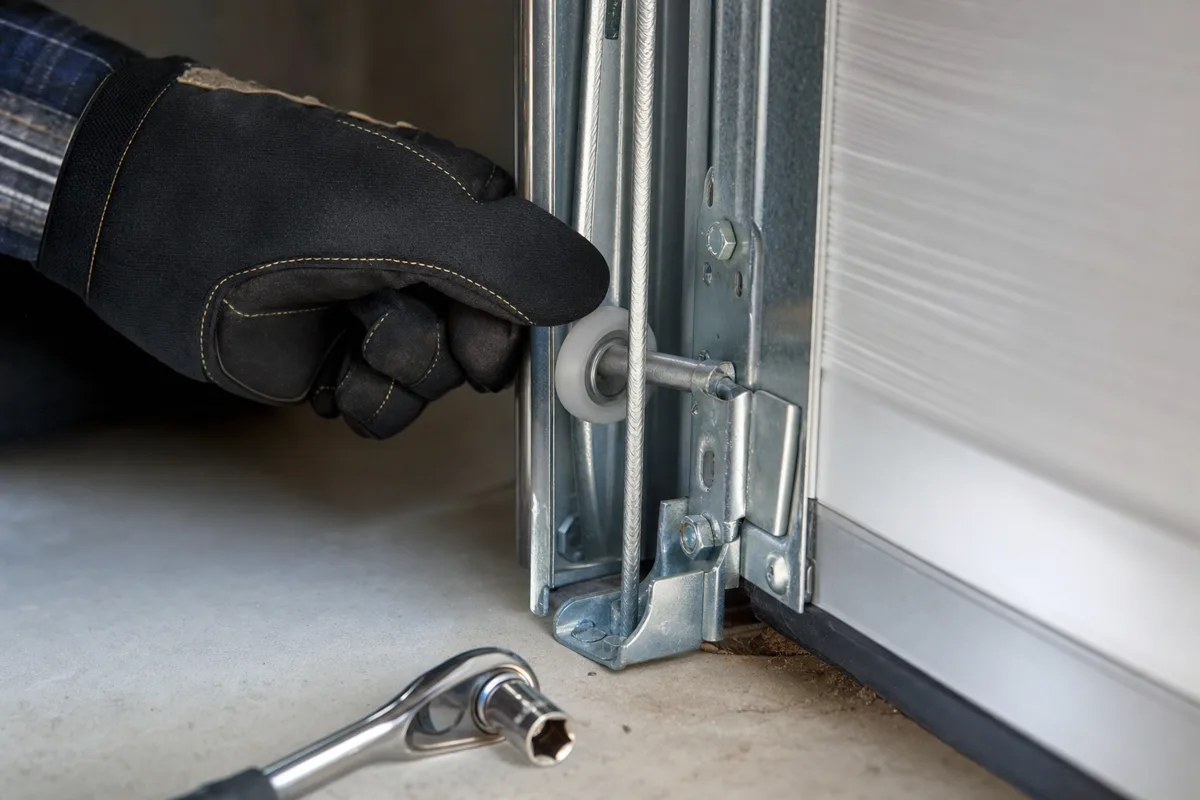

Emergency Garage Door Repair
Doors stuck open, hanging crooked, or off the guide, made safe first.
View serviceA door out of its track is unevenly supported. Stop using the opener before anything else.
Stop using the opener immediately and disconnect it at the release cord so nobody else tries. Move any vehicle out from under the door if it can be done safely, and keep children and pets away from the opening. Do not try to lever the roller back into the track or lift the door — the bottom brackets are under spring tension and the door can drop. Note which side dropped and how far the door had travelled, and send that with the request.
An off-track door is unmistakable: one side has dropped, the bottom edge runs at an angle across the opening, and the door is jammed where it stands. What is less obvious is that the door is no longer properly supported — a roller has left its track, a cable may have come off its drum, and the load path the door was designed around has changed. That is why the first instruction is the same for everyone: stop pressing the button. In Milton the narrow platted frontages leave very little side room, so an off-track door frequently fouls the wall or a bracket as well.
Start at the top. The early checks are the most common causes and need no tools.
Pull the emergency release cord so the door is no longer connected to the drive, and tell everyone in the household not to press the button. Each attempted cycle in this state bends track, loads one cable and can pull the door further out of the opening.
What it means: This one action prevents most of the additional damage an off-track door suffers.
Move any vehicle out from under the door if it can be done without going beneath the jammed section, and keep children, pets and anything valuable out of the doorway. Do not stand in the opening to inspect it — look from the side.
What it means: Nothing should be under a door that is not properly supported.
From a safe angle, note which side has dropped, whether a cable is hanging slack or off its drum, whether a spring shows a gap in the coil, and whether the track is visibly bent or splayed. Photographs are genuinely useful for preparing the visit.
What it means: What you can see determines whether this is a track job or a spring and cable job.
Check the bottom half-metre of both vertical tracks for a dent, a knock or a build-up of frozen grit, and think back to whether anything struck the track — a bumper, a bike, a bin or a shovel. On tight Milton openings a few millimetres of movement is enough.
What it means: Finding the cause stops the same failure repeating after the repair.
If the door is stuck open, the garage is not secure, so move what matters and use the walk-through door to the house. Send the symptom marked urgent with the side that dropped, whether a vehicle is trapped and whether a cable or spring looks damaged.
What it means: A clear description means the right parts arrive on the first visit.
An off-track door is one of the genuinely hazardous states a garage door reaches. It is unevenly supported, the bottom roller brackets are attached to lift cables under full spring tension, and levering a roller back into the track can release that load or let the door drop. Never work under a jammed door, never attempt to lift it back into line, and never cycle it to see whether it will straighten itself out. Keep the opener disconnected until it has been repaired.
Milton’s geometry is why this happens here. Design guidance sets a one-car garage on lots under twelve metres at between 2.9 and 5.0 metres wide, Boyne-area townhouses are platted at 6.0-metre frontages, and Timberlea’s Area 2 averages 11.1 metres of frontage with 94 per cent of lots under 15 metres. Tight openings mean minimal side room and no tolerance for a track knocked out of line. Add driveways held between 5.5 and 7.0 metres deep, and vehicles, bins and shovels spend every day within centimetres of the track.
Fill out the form and we'll confirm your appointment by email.
These guides are written for Milton homes. If the fix is beyond a homeowner check, we work everywhere inside this area.
Map data © Google. Pin shows the service area, not a walk-in location — all work is done at your home.
A real callout, not stock imagery.
A sectional door pulled off its tracks, taken down and supported on site so it could be checked and re-hung safely — photographed on the job.
