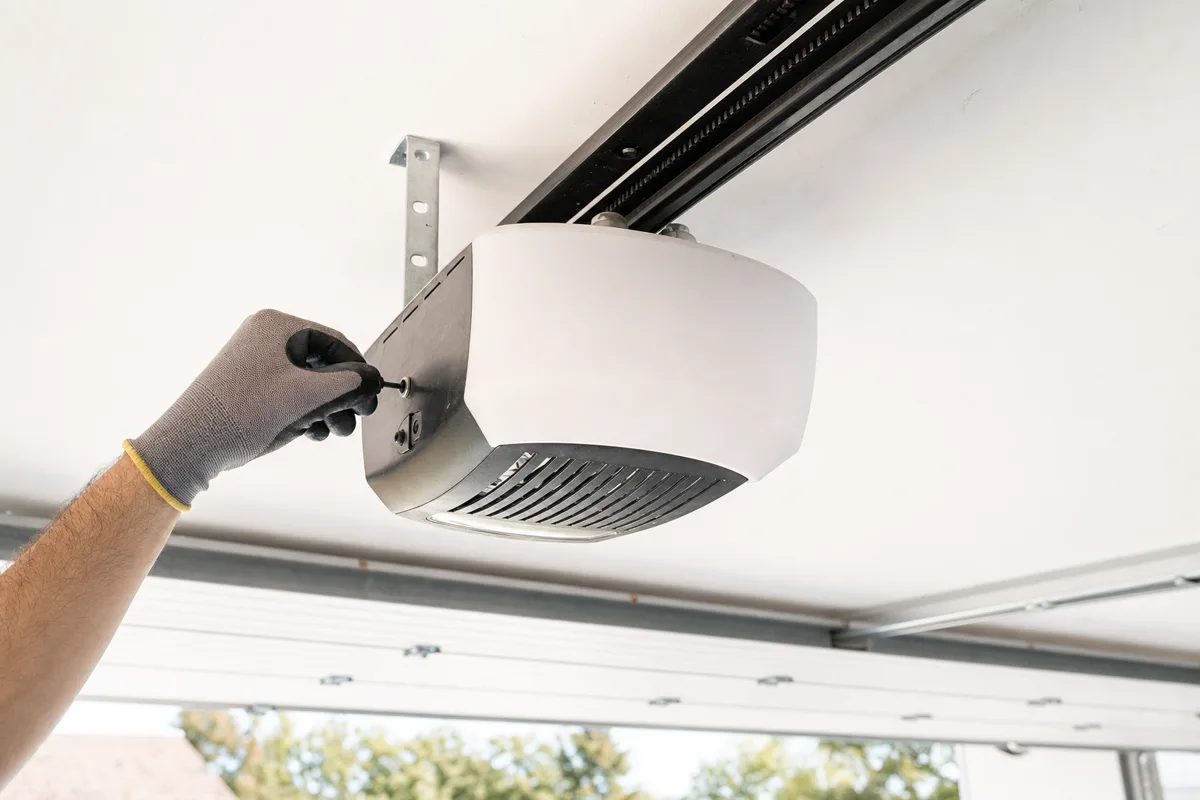

Garage Door Opener Repair
Drive, sensor, board and limit faults separated from door faults.
View serviceA door that goes up but will not stay down is usually protecting you from something. Here is how to find out what.
If the door starts down and reverses, suspect the photo eyes first: clear the threshold, wipe both lenses, and check that neither bracket has been knocked out of line. If the door will not move at all, disconnect the opener with the door closed and lift by hand — a heavy door is a counterbalance problem, not an opener problem. If it closes only while you hold the wall button down, the safety system is reporting a fault and needs fixing rather than overriding.
Of all the garage door symptoms people search for, this is the one most often solved without a service visit. A modern opener refuses to close for a defined set of reasons: its photo-eye beam across the opening is broken or misaligned, it meets more resistance on the way down than its learned force setting expects, its travel limits are wrong, or something mechanical is fouling near the floor. In Milton the first of those causes is the standout, because the sensors sit within a hand-span of a slab that collects salted slush and meltwater through a winter bringing roughly 161.4 cm of snow. Work from the floor upward and the answer normally presents itself in a few minutes.
Start at the top. The early checks are the most common causes and need no tools.
Look along the full width of the threshold from inside and out. A shovel handle, a bag of salt, a bike wheel, a ridge of frozen slush or a snow bank pushed against the opening will all break the beam or stop the door. This is the most frequent cause in a Milton winter and it takes ten seconds to rule out.
What it means: If clearing the threshold fixes it, nothing is broken and no visit is needed.
The two small sensors face each other a few centimetres above the slab. Wipe both lenses with a dry cloth — road-salt film and condensation are enough on their own — then check the indicator lights. Most units show a steady light when the pair is aligned and a flickering or dark one when it is not. A bin or a shovel knocking a bracket is all it takes.
What it means: Steady lights and a clean beam clear the safety system as the cause.
A low sun angle shining directly into the receiving sensor can swamp the beam and make the door reverse at a particular time of day and no other. Milton’s west-facing openings toward the escarpment see this on clear winter afternoons. Shade the sensor with your hand and try again to test it.
What it means: A fault that appears only at one time of day usually means sunlight, not a failed part.
Press and hold the wall button rather than using a remote. If the door closes fully while held, the opener and motor are fine and the safety circuit is what is objecting. If it does nothing from the wall control either, the fault is in the operator or its supply rather than in the radio or the sensors.
What it means: This single test separates a safety-system fault from an operator fault.
With the door closed, pull the emergency release, then lift by hand and lower it slowly. Watch for a point where it binds, catches or drops the last stretch, and look for a roller out of its track or a visible gap in a spring coil above the door. Any of those means the resistance the opener is reacting to is real.
What it means: A door that binds by hand needs mechanical work; stop using the opener until then.
Never disable the safety reverse or hold the button down as a permanent workaround. That reverse is what stops a closing door on a child, a pet or a bumper, and a door refusing to close is the system doing its job. Do not increase the force setting to make a symptom disappear either — if the door meets real resistance, raising the force just means the door pushes harder against whatever is in the way. And if you find a broken spring or a door off its track, leave it alone: those are tensioned components.
This is a winter-weighted problem in Milton. The town records about 45.2 cm of snow in January against a daily mean of -6.8 C, and snow cleared from a driveway held to between 5.5 and 7.0 metres deep under the Boyne Survey guidelines usually ends up piled near the opening rather than well away from it. That puts ice at the threshold and slush across the sensor lenses through the months the door is used most. Projecting garages are the most exposed of all: 80 per cent of Timberlea garages project forward of the front wall.
Fill out the form and we'll confirm your appointment by email.
These guides are written for Milton homes. If the fix is beyond a homeowner check, we work everywhere inside this area.
Map data © Google. Pin shows the service area, not a walk-in location — all work is done at your home.

A real callout, not stock imagery.
A sectional door pulled off its tracks, taken down and supported on site so it could be checked and re-hung safely — photographed on the job.
